Acquisition Module
Acquisition is responsible for managing the process of waveform data acquisition.
Data acquisition has two modes: Test and Run: Test and Run. The Test mode can be understood as a debugging mode, where real-time adjustments to the Cracker configuration and data acquisition settings can be made to achieve better data collection results (currently, this mode is meaningful only in the Jupyter environment, where waveforms can be viewed in real-time through the oscilloscope panel). In this mode, the acquired waveform data is not saved.
In the Run mode, the user cannot make real-time configurations to the device. This mode is mainly used for data collection after various parameter adjustments are completed. In this mode, the user can specify the file path and file format for saving the data.
The acquisition process consists of the following steps:
Pre-initialization
Initialization
Post-initialization
Pre-acquisition
Data acquisition
Post-acquisition
Pre-completion
Completion
Post-completion
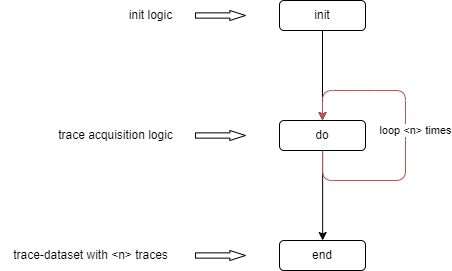
The end user mainly needs to focus on the Initialization and Data Acquisition steps, which are the init and do methods of the Acquisition class in the code. Typically, key settings for the device are made in init, while specific operations like encrypted data transmission and result reception are handled in do.
The flowchart is shown below:
Acquisition
- class cracknuts.acquisition.acquisition.Acquisition(cracker, trace_count=1000, sample_length=-1, sample_offset=0, data_plaintext_length=None, data_ciphertext_length=None, data_key_length=None, data_extended_length=None, trigger_judge_wait_time=0.01, trigger_judge_timeout=1.0, do_error_handler_strategy=0, do_error_max_count=-1, file_format='zarr', file_path='auto', trace_fetch_interval=0)[source]
Bases:
ABCTrace acquisition process control class
-
DO_ERROR_HANDLER_STRATEGY_CONTINUE_UNTIL_MAX_ERROR_COUNT:
int= 1
-
DO_ERROR_HANDLER_STRATEGY_EXIT:
int= 0
- MAX_WAVE_LENGTH = 32000000
-
STATUS_GLITCH_TEST_RUNNING:
int= 3
-
STATUS_RUNNING:
int= 2
-
STATUS_STOPPED:
int= 0
-
STATUS_TESTING:
int= 1
- __abstractmethods__ = frozenset({'do', 'init'})
- __annotations__ = {'DO_ERROR_HANDLER_STRATEGY_CONTINUE_UNTIL_MAX_ERROR_COUNT': <class 'int'>, 'DO_ERROR_HANDLER_STRATEGY_EXIT': <class 'int'>, 'STATUS_GLITCH_TEST_RUNNING': <class 'int'>, 'STATUS_RUNNING': <class 'int'>, 'STATUS_STOPPED': <class 'int'>, 'STATUS_TESTING': <class 'int'>, '_STATUS_PAUSED_SWITCH': <class 'int'>, '_do_error_max_count': 'int', '_file_format': 'str', '_file_path': 'str', '_last_wave': 'dict[int, np.ndarray] | None', '_on_config_changed_listener': 'list[typing.Callable[[str, typing.Any], None]]', '_on_run_progress_changed_listeners': 'list[typing.Callable[[dict], None]]', '_on_status_change_listeners': 'list[typing.Callable[[int], None]]', '_on_wave_loaded_callback': 'typing.Callable[[typing.Any], None] | None', '_run_thread_pause_event': 'threading.Event', '_sample_offset': 'int', '_status': 'int', '_trace_count': 'int', '_trigger_judge_timeout': 'float', '_trigger_judge_wait_time': 'float', 'cracker': 'CrackerBasic', 'do_error_handler_strategy': 'int', 'metadata_ciphertext_length': 'int', 'metadata_extended_length': 'int', 'metadata_key_length': 'int', 'metadata_plaintext_length': 'int'}
- __dict__ = mappingproxy({'__module__': 'cracknuts.acquisition.acquisition', '__annotations__': {'STATUS_STOPPED': <class 'int'>, 'STATUS_TESTING': <class 'int'>, 'STATUS_RUNNING': <class 'int'>, 'STATUS_GLITCH_TEST_RUNNING': <class 'int'>, '_STATUS_PAUSED_SWITCH': <class 'int'>, 'DO_ERROR_HANDLER_STRATEGY_EXIT': <class 'int'>, 'DO_ERROR_HANDLER_STRATEGY_CONTINUE_UNTIL_MAX_ERROR_COUNT': <class 'int'>, '_last_wave': 'dict[int, np.ndarray] | None', '_status': 'int', '_run_thread_pause_event': 'threading.Event', 'cracker': 'CrackerBasic', '_trace_count': 'int', '_sample_offset': 'int', 'metadata_plaintext_length': 'int', 'metadata_ciphertext_length': 'int', 'metadata_key_length': 'int', 'metadata_extended_length': 'int', '_trigger_judge_wait_time': 'float', '_trigger_judge_timeout': 'float', 'do_error_handler_strategy': 'int', '_do_error_max_count': 'int', '_file_format': 'str', '_file_path': 'str', '_on_wave_loaded_callback': 'typing.Callable[[typing.Any], None] | None', '_on_status_change_listeners': 'list[typing.Callable[[int], None]]', '_on_run_progress_changed_listeners': 'list[typing.Callable[[dict], None]]', '_on_config_changed_listener': 'list[typing.Callable[[str, typing.Any], None]]'}, '__doc__': '\n Trace acquisition process control class\n ', 'STATUS_STOPPED': 0, 'STATUS_TESTING': 1, 'STATUS_RUNNING': 2, 'STATUS_GLITCH_TEST_RUNNING': 3, '_STATUS_PAUSED_SWITCH': -1, 'DO_ERROR_HANDLER_STRATEGY_EXIT': 0, 'DO_ERROR_HANDLER_STRATEGY_CONTINUE_UNTIL_MAX_ERROR_COUNT': 1, '_DATASET_DEFAULT_PATH': './dataset/', 'MAX_WAVE_LENGTH': 32000000, '__init__': <function Acquisition.__init__>, 'on_config_changed': <function Acquisition.on_config_changed>, 'trace_count': <property object>, 'sample_length': <property object>, 'sample_offset': <property object>, 'trigger_judge_wait_time': <property object>, 'trigger_judge_timeout': <property object>, 'do_error_max_count': <property object>, 'file_format': <property object>, 'file_path': <property object>, 'trace_fetch_interval': <property object>, 'get_status': <function Acquisition.get_status>, 'set_cracker': <function Acquisition.set_cracker>, 'on_status_changed': <function Acquisition.on_status_changed>, 'on_run_progress_changed': <function Acquisition.on_run_progress_changed>, 'on_wave_loaded': <function Acquisition.on_wave_loaded>, 'run': <function Acquisition.run>, 'run_sync': <function Acquisition.run_sync>, 'test': <function Acquisition.test>, 'test_sync': <function Acquisition.test_sync>, 'pause': <function Acquisition.pause>, 'resume': <function Acquisition.resume>, 'stop': <function Acquisition.stop>, '_run': <function Acquisition._run>, '_do_run': <function Acquisition._do_run>, '_status_changed': <function Acquisition._status_changed>, '_loop': <function Acquisition._loop>, '_progress_changed': <function Acquisition._progress_changed>, '_loop_without_log': <function Acquisition._loop_without_log>, 'connect_scrat': <function Acquisition.connect_scrat>, 'connect_cracker': <function Acquisition.connect_cracker>, 'connect_net': <function Acquisition.connect_net>, 'config_scrat': <function Acquisition.config_scrat>, 'config_cracker': <function Acquisition.config_cracker>, 'pre_init': <function Acquisition.pre_init>, 'init': <function Acquisition.init>, '_post_init': <function Acquisition._post_init>, 'transfer': <function Acquisition.transfer>, 'pre_do': <function Acquisition.pre_do>, 'do': <function Acquisition.do>, '_do': <function Acquisition._do>, '_post_do': <function Acquisition._post_do>, '_is_triggered': <function Acquisition._is_triggered>, '_get_waves': <function Acquisition._get_waves>, '_pre_finish': <function Acquisition._pre_finish>, '_post_finish': <function Acquisition._post_finish>, '_save_dataset': <function Acquisition._save_dataset>, 'finish': <function Acquisition.finish>, 'get_last_wave': <function Acquisition.get_last_wave>, 'dump_config': <function Acquisition.dump_config>, 'load_config_from_file': <function Acquisition.load_config_from_file>, 'load_config_from_str': <function Acquisition.load_config_from_str>, 'load_config_from_json': <function Acquisition.load_config_from_json>, 'is_running': <function Acquisition.is_running>, '__dict__': <attribute '__dict__' of 'Acquisition' objects>, '__weakref__': <attribute '__weakref__' of 'Acquisition' objects>, '__abstractmethods__': frozenset({'do', 'init'}), '_abc_impl': <_abc._abc_data object>})
- __init__(cracker, trace_count=1000, sample_length=-1, sample_offset=0, data_plaintext_length=None, data_ciphertext_length=None, data_key_length=None, data_extended_length=None, trigger_judge_wait_time=0.01, trigger_judge_timeout=1.0, do_error_handler_strategy=0, do_error_max_count=-1, file_format='zarr', file_path='auto', trace_fetch_interval=0)[source]
- Parameters:
cracker (CrackerBasic) – The controlled Cracker object.
trace_count (int) – The number of traces to acquire.
sample_length (int) – the sample length to be acquired, If it is -1, it will be set to the value of cracker.current_count().sample_len.
sample_offset (int) – the sample offset to be acquired.
trigger_judge_timeout (float) – The trigger judge timeout in seconds.
trigger_judge_wait_time (float) – The trigger judge wait time in seconds.
do_error_handler_strategy (int) – The strategy to handle error handling. 0: Exit immediately, 1: Exit after exceeding the error count.
do_error_max_count (int) – The maximum number of error count. If do_error_handler_strategy is 0, this setting is invalid.
file_format (str) – The file format of the trace dataset. “zarr” or “numpy”.
file_path (str) – The file path of the trace dataset. If set to “auto”, a folder with a timestamp format will be created in the current working directory to save the data.
- __module__ = 'cracknuts.acquisition.acquisition'
- __weakref__
list of weak references to the object
- config_cracker()[source]
- config_scrat()[source]
- connect_cracker()[source]
Connect to cracker device.
- connect_net()[source]
- connect_scrat()[source]
Connect to scrat device.
- abstractmethod do(count)[source]
The
dologic, which the user should implement in the subclass.The returned dictionary should contain
plaintextandciphertextkeys and may optionally includekeyandextendedkeys. The plaintext is the data to be encrypted, the ciphertext is the encrypted result, the key is used to encrypt the plaintext, and the extended field is for any custom data you want to save. Expected structure:{"plaintext": bytes, "ciphertext": bytes, "key": bytes, "extended": bytes}.- Parameters:
count (int) – The loop count, starting from 0.
- Returns:
Data in dictionary format to be saved.
- Return type:
dict[str, bytes]
- property do_error_max_count
- dump_config(path=None)[source]
Dump the current config to a JSON file if a path is specified, or to a JSON string if no path is specified.
- Parameters:
path (str | None) – The path to the JSON file.
- Returns:
The JSON string content, or None if a file path was specified.
- Return type:
str | None
- property file_format
- property file_path
- finish()[source]
- get_last_wave()[source]
Get the last acquired wave.
- Returns:
Dictionary mapping channel index to wave data array, or None if not yet available.
- Return type:
dict[int, np.ndarray] | None
- get_status()[source]
- abstractmethod init()[source]
The init logic, which the user should implement in the subclass.
- is_running()[source]
- load_config_from_file(path)[source]
Load config from a JSON file.
- Parameters:
path (str) – The path to the JSON file.
- Return type:
None- Returns:
None
- load_config_from_json(config)[source]
Load config from a JSON object.
- Parameters:
config (dict) – The JSON object containing configuration values.
- Returns:
None
- load_config_from_str(json_str)[source]
Load config from a JSON string.
- Parameters:
json_str (str) – The JSON string.
- Return type:
None- Returns:
None
- on_config_changed(listener)[source]
- on_run_progress_changed(callback)[source]
- Return type:
None
- on_status_changed(callback)[source]
User should not use this function. If you need to perform actions when the ACQ state changes, please use the node functions in the ACQ lifecycle point:
init,do, andfinish.Status values: 0 = stopped, 1 = testing, 2 = running, 3 = paused.
- Parameters:
callback (Callable[[int], None]) – Callable that receives the new status integer.
- Return type:
None- Returns:
None
- on_wave_loaded(callback)[source]
- Return type:
None
- pause()[source]
Pause test or run mode.
- pre_do()[source]
- pre_init()[source]
- resume()[source]
Resume from paused test or run mode.
- run(count=None, sample_length=None, sample_offset=None, data_plaintext_length=None, data_ciphertext_length=None, data_key_length=None, data_extended_length=None, trigger_judge_wait_time=None, trigger_judge_timeout=None, do_error_max_count=None, do_error_handler_strategy=None, file_format=None, file_path=None)[source]
Start run mode in the background. The parameters configured here will override the settings specified in __init__.
- Parameters:
count (int) – The number of traces to acquire.
sample_length (int) – The sample length to be acquired.
sample_offset (int) – The sample offset to be acquired.
trigger_judge_wait_time (float) – The trigger judge wait time in seconds.
trigger_judge_timeout (float) – The trigger judge timeout in seconds.
do_error_max_count (int) – The maximum number of error count. If do_error_handler_strategy is 0, this setting is invalid.
do_error_handler_strategy (int) – The strategy to handle error handling. 0: Exit immediately, 1: Exit after exceeding the error count.
file_format (str) – The file format of the trace dataset. “zarr” or “numpy”.
file_path (str) – The file path of the trace dataset. If set to “auto”, a folder with a timestamp format will be created in the current working directory to save the data.
- run_sync(count=1, sample_length=1024, sample_offset=0, trigger_judge_wait_time=None, trigger_judge_timeout=None, do_error_max_count=None, do_error_handler_strategy=None, file_format='zarr', file_path='auto')[source]
Start run mode in the foreground, which will cause blocking.
- Parameters:
count (int) – The number of traces to acquire.
sample_length (int) – The sample length to be acquired.
sample_offset (int) – The sample offset to be acquired.
trigger_judge_wait_time (float) – The trigger judge wait time in seconds.
trigger_judge_timeout (float) – The trigger judge timeout in seconds.
do_error_max_count (int) – The maximum number of error count. If do_error_handler_strategy is 0, this setting is invalid.
do_error_handler_strategy (int) – The strategy to handle error handling. 0: Exit immediately, 1: Exit after exceeding the error count.
file_format (str) – The file format of the trace dataset. “zarr” or “numpy”.
file_path (str) – The file path of the trace dataset. If set to “auto”, a folder with a timestamp format will be created in the current working directory to save the data.
- property sample_length
- property sample_offset
- set_cracker(cracker)[source]
- stop()[source]
Stop test or run mode.
- test(sample_length=None, sample_offset=None, trigger_judge_wait_time=None, trigger_judge_timeout=None, do_error_max_count=None, do_error_handler_strategy=None, trace_fetch_interval=2.0)[source]
Start test mode in background.
- Parameters:
count (int) – The number of traces to acquire. normally this value should be -1.
sample_length (int) – The sample length to be acquired.
sample_offset (int) – The sample offset to be acquired.
trigger_judge_wait_time (float) – The trigger judge wait time in seconds.
trigger_judge_timeout (float) – The trigger judge timeout in seconds.
do_error_max_count (int) – The maximum number of error count. If do_error_handler_strategy is 0, this setting is invalid.
do_error_handler_strategy (
int|None) – The strategy to handle error handling. 0: Exit immediately, 1: Exit after exceeding the error count.
- test_sync(count=-1, sample_length=None, sample_offset=None, trigger_judge_wait_time=None, trigger_judge_timeout=None, do_error_max_count=None, do_error_handler_strategy=None)[source]
Start test mode in foreground, which will cause blocking.
- Parameters:
count (int) – The number of traces to acquire. normally this value should be -1.
sample_length (int) – The sample length to be acquired.
sample_offset (int) – The sample offset to be acquired.
trigger_judge_wait_time (float) – The trigger judge wait time in seconds.
trigger_judge_timeout (float) – The trigger judge timeout in seconds.
do_error_max_count (int) – The maximum number of error count. If do_error_handler_strategy is 0, this setting is invalid.
do_error_handler_strategy (
int|None) – The strategy to handle error handling. 0: Exit immediately, 1: Exit after exceeding the error count.
- property trace_count
- property trace_fetch_interval
- transfer()[source]
- property trigger_judge_timeout
- property trigger_judge_wait_time
-
DO_ERROR_HANDLER_STRATEGY_CONTINUE_UNTIL_MAX_ERROR_COUNT: